
SEAFDEC/IFRDMD Exploring Eel Fisheries and River Habitats in Bengkulu
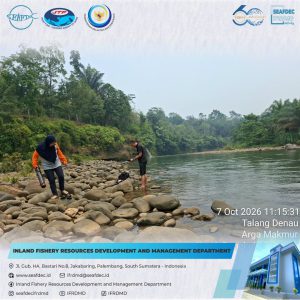 How do local fishers catch eels, and what can their knowledge tell us about eel habitats? These were among the questions explored by staff of SEAFDEC’s Inland Fishery Resources Development and Management Department (IFRDMD) and Bengkulu University during field surveys in Bengkulu from 6 to 9 October 2026.
Supported by the Japan Trust Fund (JTF) VIII, the surveys were part of the project “Enhanced Research Capacities for Sustainable Utilization and Management of Eel and Other Inland Fisheries Resources.” Through field observations and discussions with local fishers, the team documented fishing practices, traditional ecological knowledge, and river habitat conditions.
Learning from Local Fishers
In Air Palik, North Bengkulu, fishers use a traditional fishing gear called tajur, a longline baited with shrimp and fitted with around 8–10 hooks. The gear is set in afternoon and retrieved the following morning. Several eel specimens, provisionally identified as longfin anguillid eels, were collected for further examination. Eels are also consumed locally, reflecting their role in both community livelihoods and local food traditions.
Local knowledge adds another layer to the findings. Fishers distinguish between eels called “selan lelew” and “selan bingin.” They describe “selan lelew” as moving between locations while “selan bingin” is associated with shaded areas. Further scientific examination is needed to determine whether these local names refer to different eel species.
Checking River Habitats and Connectivity
The team also surveyed the Air Palik and Air Lais rivers in North Bengkulu. At the Air Palik estuary, residents reported that some areas had become deeper following changes associated with fishing port development. In the Air Lais River, an upstream irrigation dam reportedly supplies water to around 6,000 hectares of rice fields. During the survey, the team observed no substantial habitat changes at the river’s estuary.
Further south, the team explored the Air Manna River, extending the survey upstream to the Tanjung Sakti area. No dam was recorded along the surveyed upstream section, and the estuary showed limited evidence of habitat alteration. An interesting finding came from Tanjung Sakti, where two eel specimens suspected to be longfin anguillid eels were collected using hook-and-line fishing at approximately 1,000 metres above sea level.
What Do These Findings Tell Us?
The specimens collected in Tanjung Sakti provide preliminary evidence of eel occurrence in upland freshwater habitats within the surveyed river system. This highlights the importance of understanding how eels use river systems and move between estuarine and upstream habitats. Maintaining river connectivity may be important for supporting eel movements and sustaining their populations. However, the elevation of a collection site alone cannot determine how far eels have travelled inland. Estimating migration distance requires measuring the river route from the estuary to the collection site.
By combining scientific surveys with the knowledge of local fishing communities, SEAFDEC/IFRDMD and its partners are building a better understanding of eel fisheries and river habitats. These findings will contribute to ongoing research to support the sustainable utilization and management of eel and other inland fisheries resources.