
SEAFDEC/IFRDMD Connects Sustainable Fisheries with Stronger Community Enterprises
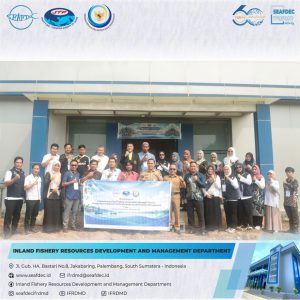 Palembang, 28 October 2026. Helping fishing communities turn local fisheries resources into sustainable business opportunities was the focus of a three-day workshop organized by the SEAFDEC/Inland Fishery Resources Development and Management Department (SEAFDEC/IFRDMD) in Palembang on 26–28 October 2026.
The Workshop on Empowering Inland Fishing Communities through Fisheries Enterprise Development and Community-based Fisheries Management brought together three representatives from Malaysia, 25 participants from Indonesia, and four business practitioners. Supported by the Japanese Trust Fund VII under the project Improving Fishers’ Livelihood and Fisheries Co-management in Inland and Coastal Small-scale Fisheries (2025–2029), the workshop combined practical training, business discussions, and field visits to explore ways of strengthening community enterprises while sustaining fisheries resources.
Opening the workshop, Chief of SEAFDEC/IFRDMD Maulana Firdaus, Ph.D., emphasized the importance of helping fishing communities manage fisheries resources responsibly while developing enterprises that improve their livelihoods. Exchanges between Indonesia and Malaysia, alongside cooperation among fisheries institutions, extension officers, and business operators, provided opportunities to explore practical approaches to community-based fisheries management and enterprise development.
The first day featured a hands-on session introducing the Malaysian representatives to Palembang’s traditional fish-based products, including pempek and laksan. At the Extension Demonstration and Innovation Installation in Palembang, participants learned about ingredient selection, processing techniques, hygiene, and product quality under the guidance of instructors and fisheries extension officers from the Ministry of Marine Affairs and Fisheries.
The session also prompted discussions on adapting local food products to other communities. Participants considered ingredient availability, production capacity, and consumer preferences, as well as the steps needed to turn food processing skills into viable businesses, including calculating production costs and identifying suitable markets.
On the second day, the Head of BRPPUPP, Rezki Anthoni; the Head of the Ogan Ilir District Fisheries Office, Dr. Yohanas; and the Head of the Muara Enim District Fisheries Office, Dr. Freddy Febriansyah, shared experiences of the benefits of SEAFDEC/IFRDMD activities for their institutions and partner communities.
Four business practitioners then offered insights into different aspects of enterprise development. The owner of Pempek Sentosa discussed fisheries entrepreneurship and sustainable business models. The Director of PT Karya Rasa and Founder of Lapis Bogor Sangkuriang shared experiences in branding, packaging, and digital marketing. The owner of Pempek Syamil discussed product innovation and value addition, while the Manager of PT Awan Crackers Food Indonesia introduced export opportunities and the preparations needed to enter international markets.
Their presentations highlighted the importance of product quality, branding, consumer awareness, and production capacity in building competitive businesses. Participants were encouraged to identify market opportunities that matched their resources and capabilities rather than pursuing expansion without adequate preparation.
During a follow-up planning session, Dr. Dina Muthmainnah stressed that enterprise development must go hand in hand with responsible fisheries resource management. Participants identified practical steps for their communities, including testing new products, recording production costs, improving packaging, exploring markets, and monitoring raw material use.
The workshop concluded on 27 October with closing remarks from Deputy Chief of SEAFDEC/IFRDMD Mr. Toru Shimoda, who encouraged participants to apply their learning through realistic actions suited to local needs. He also emphasized the importance of maintaining communication and sharing experiences beyond the workshop.
On 28 October, field visits gave participants a closer look at fisheries production and supply chain management. Following an introduction to the facilities at the SEAFDEC/IFRDMD office, participants visited the Rizkyanti of Pempek, Kerupuk and Kemplang Production Facility, known as Pempek Rizky. They observed production processes, quality control, packaging, branding, and business management, gaining practical insights into the day-to-day operations of a fisheries enterprise.
The final visit to the cold storage facility at Jakabaring Fish Market highlighted the role of proper handling and storage in maintaining fish quality and ensuring reliable raw material supplies for processing and marketing.
By combining practical training, business experiences, and field observations, the workshop connected fisheries resource management with the everyday realities of running a business. The activity also reinforced the value of cooperation among fisheries institutions, extension officers, business operators, and fishing communities.
Through continued collaboration with national and regional partners, SEAFDEC/IFRDMD aims to support fisheries enterprises that create economic opportunities for local communities while promoting the sustainable use of inland fisheries resources.