
SEAFDEC/IFRDMD Supports Swamp Ecosystem Conservation through Eco-Literacy and Greenbelt Revegetation in Patra Tani
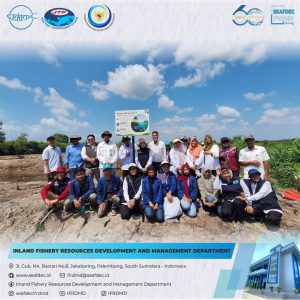 The Southeast Asian Fisheries Development Center/Inland Fishery Resources Development and Management Department (SEAFDEC/IFRDMD) participated in the “Eco-Literacy and Greenbelt Revegetation of Swamp Conservation Ponds” activity at the Patra Tani Installation, Muara Belida Subdistrict, Muara Enim Regency, South Sumatra, on 14 July 2026.
The event was attended by the Head of the Research Institute for Inland Fisheries and Fisheries Extension (RIIFE), the Deputy Chief of SEAFDEC/IFRDMD, the representative of Forest Tree Seed Center (BPTH) Region I Palembang, the Head of Muara Belida Subdistrict, the Head of Patra Tani Village, fisheries extension officers, RIIFE and IFRDMD staff, local community representatives, and university students.
During the opening session, the Head of RIIFE, Mr. Rezki Anthoni, emphasized the importance of cross-sectoral collaboration in managing swamp ecosystems. Inland fisheries management is closely linked to the surrounding land, vegetation, water flow, soil, and aquatic habitats. Cooperation between the fisheries and forestry sectors is therefore essential to ensure that conservation efforts address the ecosystem as an interconnected whole.
The activity featured a mini-talk show entitled “The Synergy of Swamp Forest Trees as the Heart of Aquatic Ecosystems,” combining perspectives from the forestry and inland fisheries sectors. The session introduced participants to the ecological characteristics of swamp forest trees and their role in sustaining the productivity and resilience of aquatic ecosystems.
The Forest Tree Seed Center (BPTH) Region I Palembang, Mr. Muhammad Iftor, explained the types of swamp-adapted seedlings used in the revegetation activity and their ability to grow under challenging soil and hydrological conditions. Participants also learned appropriate planting techniques for flood-prone, highly acidic swamp areas and the importance of selecting suitable sites to improve seedling survival.
From the fisheries perspective, Dr. Dina Muthmainnah, a staff member of RIIFE and SEAFDEC/IFRDMD, explained that swamp forest vegetation supports aquatic food webs and provides habitats for fish and other aquatic organisms. She emphasized that the ecological benefits of trees extend beyond their visible parts.
After the indoor session, participants moved to the greenbelt surrounding the swamp conservation ponds. The Forest Tree Seed Center symbolically handed over swamp forest seedlings to the Head of RIIFE in support of revegetation and aquatic habitat restoration. All participants then planted the seedlings along the designated greenbelt zone. The activity enabled participants not only to learn about the importance of swamp vegetation but also to take part directly in conservation efforts to strengthen the ecological functions of the conservation ponds.
The event concluded with the installation of educational signage and a group photo near the swamp conservation ponds. The signage is expected to inform visitors and local communities about the ecological importance of the greenbelt and the need to protect the newly planted trees. Through this initiative, SEAFDEC/IFRDMD and its partners reaffirmed that protecting fishery resources begins with protecting their habitats.