
IFRDMD Participates in South Sumatra Meeting on Revitalizing the Lebak, Lebung and River Auction System
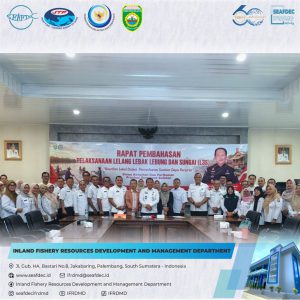 On 26 August 2026, staff of the Southeast Asian Fisheries Development Center/Inland Fishery Resources Development and Management Department (SEAFDEC/IFRDMD) participated in a meeting organized by the Marine and Fisheries Service of South Sumatra Province to discuss the implementation and future development of the Lebak, Lebung and River Auction System (Lelang Lebak, Lebung dan Sungai/L3S).
The meeting, held at the Office of the Marine and Fisheries Service of South Sumatra Province, aimed to gather information, experiences, and perspectives regarding the implementation of L3S in several districts across South Sumatra. The discussion was expected to contribute to developing common understanding and identifying possible solutions to the current dynamics of L3S, particularly from the perspectives of legal frameworks, regional revenue, equitable access, and sustainability of inland fishery resources.
The meeting brought together representatives from various institutions and stakeholders, including heads and representatives of fisheries services from eight districts where L3S activities are implemented, academics, the Research Institute for Inland Fisheries and Extension (RIIFE), and SEAFDEC/IFRDMD.
The meeting was officially opened by the Head of the Marine and Fisheries Service of South Sumatra Province, Mr. Aries Irwan Wahyu. In his remarks, he highlighted that the L3S has long been part of inland fisheries management in South Sumatra.
L3S serves not only as a mechanism for allocating fishing and utilization rights over inland water resources, but also as a source of local revenue and a social institution governing relationships among local governments, auction winners or resource managers, financiers and fish traders, fishers, and village communities.
During the meeting, representatives of SEAFDEC/IFRDMD and RIIFE shared perspectives on strengthening L3S by balancing equitable access, economic benefits, and fisheries sustainability. The discussion emphasized that maintaining L3S as a local institution should be accompanied by efforts to ensure that local fishers have fair access to fishery resources, that economic benefits are distributed appropriately, and that resource utilization is consistent with the long-term sustainability of inland fisheries.
SEAFDEC/IFRDMD also shared lessons learned from several Southeast Asian countries where inland fisheries are managed through systems with characteristics comparable to the L3S mechanism. These regional experiences provide useful references on how local institutions, fishing rights, community participation, resource conservation, and economic interests can be integrated into fisheries management.
Another important experience shared during the meeting was the SPEECTRA Programme, which has been implemented by RIIFE in collaboration with SEAFDEC/IFRDMD in Patra Tani, South Sumatra, since 2020. The programme has provided practical lessons on integrating resource conservation, fish production enhancement, stock enhancement, and community livelihoods.
The relevance of SPEECTRA to L3S does not lie in directly replicating the programme in every auction area. Rather, its key lesson is that resource utilization, resource recovery, monitoring, and community economic benefits should be designed as an integrated package under an adaptive management approach.
At the conclusion of the meeting, participants shared the view that L3S represents an important form of local wisdom and traditional fisheries institution in South Sumatra. When appropriately managed, the system can contribute to the conservation of fishery resources, protection and management of inland waters, strengthening of local institutions, and improvement of fishers’ livelihoods and income.
Considering these benefits as well as the challenges arising from changing social, economic, legal, and environmental conditions, the participants agreed that the L3S system remains relevant and can continue to be implemented through a revitalization process.
Revitalization is expected to strengthen the positive functions of L3S while improving its governance to ensure greater transparency, equitable access for local fishers, sustainable utilization of fishery resources, effective monitoring, and a fair distribution of economic benefits.
Through its participation in this meeting, SEAFDEC/IFRDMD reaffirmed its commitment to supporting the sustainable management of inland fisheries resources through science-based approaches, regional knowledge sharing, community participation, and collaboration with national and local stakeholders.