
Hydroacoustic Study and Capacity Building on Fish Biomass Estimation Conducted in Pahang River, Malaysia
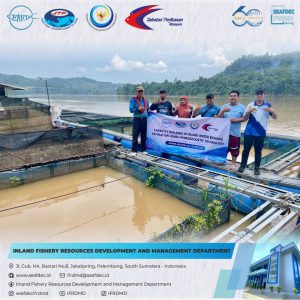 The Southeast Asian Fisheries Development Center/Inland Fishery Resources Development and Management Department (SEAFDEC/IFRDMD) further strengthened its collaboration with the Department of Fisheries Malaysia (DoF Malaysia) through a joint field study and technical capacity building program on inland fisheries assessment conducted in Pahang, Malaysia, from 27 to 30 June 2026.
The activity was carried out under the Japan Trust Fund VII-supported project entitled “Enhanced Research Capacities for Sustainable Utilization and Management of Eel and Other Inland Fisheries Resources.” It aimed to strengthen researcher technical capacity while improving fish biomass estimation in inland waters through the application of hydroacoustic technology. The activity involved two staff members of SEAFDEC/IFRDMD, one representative from the Ministry of Marine Affairs and Fisheries of Indonesia, and four staff members of the Department of Fisheries Malaysia.
The theme of the activity was “Study and Capacity Building in Inland Water Biomass Estimation Using Hydroacoustic Technology.” Estimating fish biomass in rivers and other inland waters remains one of the major challenges in many Southeast Asian countries because of the complexity of inland water ecosystems and the limitations of conventional data sampling methods. Hydroacoustic technology provides a faster, non-destructive, and more efficient alternative by using sound waves to detect and measure underwater objects, particularly fish. The reflected echoes from fish or the riverbed can be analyzed to estimate fish distribution, density, and biomass.
For the study in Pahang, SEAFDEC/IFRDMD used a portable single-beam echosounder, the Simrad EK15, operating at a frequency of 200 kHz and supported by Echoview post-processing software. Hydroacoustic data collection was also combined with biological data collection, including fish sampling, fish handling, length measurement, species composition analysis, and length-weight relationship analysis. This combination is important for improving the accuracy of fish biomass estimation and supporting data-driven fisheries management.
The field survey was conducted along the Pahang River, with survey tracks passing through several locations, including Kuala Jempol, Pulau Temiang, Pulau Musuh, Lubuk Paku, Kuala Wau, Serengkam, Sungai Luit, and KOA Tanah Merah. The activity included equipment setup, acoustic data collection, data recording, data verification, and real-time monitoring. These activities demonstrated how hydroacoustic technology can be applied in inland waters by providing wider survey coverage, enabling real-time data collection, and minimizing environmental impact.
As part of the technical activity, a follow-up experiment on fish acoustic target strength measurement was conducted in Serengkam. The experiment used 20 individual samples of baung or malayan river catfish (Hemibagrus capitulum) to obtain more accurate information for estimating fish biomass. The target strength measurement was an important component of the study, as it helped support the interpretation of acoustic signals and improve the reliability of biomass estimation.
Beyond field data collection, the activity also emphasized knowledge transfer and capacity building. SEAFDEC/IFRDMD shared technical knowledge and practical experience with DoF Malaysia staff on the application of hydroacoustic methods for inland fisheries stock assessment. Through the activity, participants gained a better understanding of biomass estimation methods and the use of acoustic technology to support sustainable inland fisheries management.
Through this initiative, SEAFDEC/IFRDMD aims to strengthen regional research capacity, improve fisheries data collection, and promote science-based management of inland fisheries resources. The collaboration with DoF Malaysia also demonstrates the shared commitment of both institutions to advancing innovative research approaches and supporting the sustainable management of inland fisheries across Southeast Asia.
The application of hydroacoustic technology also provides valuable scientific information to support Community-Based Fisheries Management (CBFM). Reliable estimates of fish biomass and distribution enable local communities and fisheries managers to make better-informed decisions on resource utilization, conservation measures, and habitat management. By strengthening the scientific basis for participatory fisheries management, hydroacoustic surveys contribute to more sustainable and community-driven inland fisheries governance.