
SEAFDEC/IFRDMD Strengthens Inland Fisheries Assessment through Hydroacoustic Technology Ranau Lake, South Sumatra and Lampung Provinces, Indonesia | 12–13 August 2026
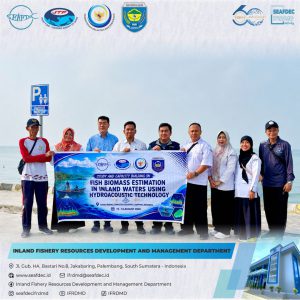 SEAFDEC/IFRDMD, in collaboration with the Research Institute for Inland Fisheries and Extension (RIIFE), Ministry of Marine Affairs and Fisheries (MMAF), Indonesia, conducted the “Study and Capacity Building on Fish Biomass Estimation in Inland Waters Using Hydroacoustic Technology” on 12–13 August 2026 at Ranau Lake, which spans South Sumatra and Lampung Provinces, Indonesia. The brought together fisheries practitioners and researchers to strengthen practical knowledge and skills in applying hydroacoustic technology for inland fisheries assessment.
The activity was also attended by staff from the Department of Fisheries of Ogan Komering Ulu Selatan Regency, further strengthening collaboration between fisheries institutions at the national, regional, and local levels in support of sustainable inland fisheries resource management. The activity received support from the Japan Trust Fund (JTF) VII as part of SEAFDEC’s continuing efforts to strengthen research capacity and promote science-based management of inland fisheries in Southeast Asia.
The main objective was to strengthen technical capacity in applying hydroacoustic technology to assess fish distribution and estimate fish biomass in inland waters. Hydroacoustic methods offer an efficient and non-invasive approach for assessing fish resources over relatively large areas and can generate valuable scientific information to support fisheries research, monitoring, and management.
During the field survey, hydroacoustic observations were conducted using two acoustic instruments: the BioSonics DTX Split-Beam Echosounder, operating at 120 kHz, and the SIMRAD EK15 Single-Beam Echosounder, operating at 200 kHz. The survey covered a total track length of approximately 42 nautical miles (nm) across Ranau Lake. The use of the two acoustic systems provided participants with practical experience in hydroacoustic survey techniques, including instrument operation, acoustic data acquisition, and fish-target characterization.
In parallel with the acoustic survey, water-quality parameters were measured and biological information on fish species composition, length, and weight was collected. These supporting data are important for interpreting acoustic observations and improving understanding of the relationship between acoustic signals and the biological characteristics of fish populations.
The fieldwork also served as a hands-on capacity-building platform, allowing participants to gain practical experience in conducting hydroacoustic surveys in inland waters. Through direct field practice, participants were able to better understand how acoustic, biological, and environmental data can be integrated to produce a more comprehensive assessment of fish distribution and biomass.
Ranau Lake is an important inland water body shared by South Sumatra and Lampung Provinces, supporting inland fisheries and the livelihoods of surrounding communities. Previous SEAFDEC/IFRDMD activities in the area have also underscored the importance of strengthening scientific knowledge and management approaches to support the sustainable utilization of fisheries resources in the lake.
The activity demonstrated how field based technology transfer and capacity building can strengthen the foundation for science based inland fisheries management. Through this collaborative activity, SEAFDEC/IFRDMD and its Indonesian partner institutions strengthened their cooperation in science-based inland fisheries management, technology transfer, and human resource development. The knowledge and practical experience gained from the survey are expected to support future applications of hydroacoustic technology and contribute to more effective and sustainable management of inland fisheries resources in Indonesia and Southeast Asia.