
The SPEECTRA Model: A Promising Conservation Approach for Sustainable Inland Fisheries Management
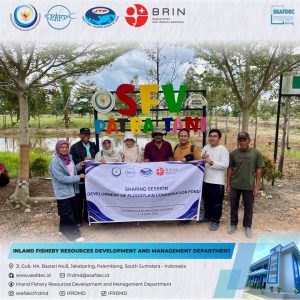 The Sharing Session on the Development of Swamp Conservation Ponds was successfully held on 7–8 April 2026 in Muara Enim and Palembang, South Sumatra. The event was officially opened by Chief of IFRDMD, Mr. Andi Soesmono. It brought together academics from Universitas Sriwijaya, Universitas PGRI, Universitas Muhammadiyah Palembang and Universitas Sjakjakirti, along with representatives from SEAFDEC/IFRDMD and RIIFE of Marine Affair and Fisheries. The session featured Prof. Dr. Ir. Husnah, M.Phil from the Indonesia Research and Innovation Agency (BRIN) as the keynote speaker, highlighting the importance of science-based approaches in inland fisheries management.
The primary objective of this activity was to exchange knowledge, experiences, and recent developments related to the establishment and management of swamp conservation ponds, with particular focus on the SPEECTRA model. Developed since 2020, SPEECTRA represents a conservation-based fisheries management approach designed to enhance fish stocks while supporting local livelihoods in swamp ecosystems.
The event began in Muara Enim Regency with a field-based activity focusing on water quality monitoring at two SPEECTRA sites, namely Patra Tani and Talang Fatimah. This hands-on assessment allowed participants to observe the current environmental conditions and gather essential data for evaluating the effectiveness of the model. The field visit also provided an opportunity to better understand the ecological dynamics of swamp areas, which are characterized by seasonal variability and play a crucial role as fish habitats.
On the second day, participants convened in Palembang for a discussion and evaluation session. The forum reviewed the findings from the field monitoring and explored both the strengths and limitations of the current implementation of the SPEECTRA model. During her presentation, Prof. Husnah emphasized the importance of conducting comprehensive evaluations, including both direct field observations and indirect analytical assessments. She highlighted that identifying existing weaknesses is a crucial step toward improving the model and ensuring its long-term sustainability.
In addition, the session showcased a successful case from a local community that has effectively managed a SPEECTRA pilot site. This example demonstrated that the model is not only technically feasible but also adaptable and capable of delivering tangible benefits to local communities. The success story served as an encouraging reference for scaling up and replicating the approach in other swamp areas.
The activity was officially closed by Head of RIIFE, Mr. Rezki Anthoni. As a token of appreciation, a souvenir was presented to the keynote speaker by Deputy Chief of IFRDMD, Mr. Toru Shimoda. The closing underscored a shared commitment to strengthen collaboration among institutions, enhance data-driven management practices, and further develop the SPEECTRA model as a sustainable solution for swamp fisheries. It is expected that continued knowledge exchange and cooperation will contribute to more resilient ecosystems and improved livelihoods for communities dependent on inland fisheries.