
SEAFDEC/IFRDMD Supports Hydroacoustic Training and Field Practicum for Fisheries Students in Lampung, Indonesia
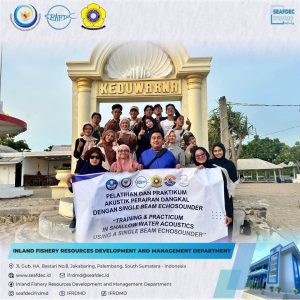 The Department of Marine Science, Universitas Sriwijaya, invited SEAFDEC/IFRDMD to support a series of training and field practicum activities on marine fisheries acoustics and shallow water acoustics in Lampung Province, Indonesia. In response to this invitation, SEAFDEC/IFRDMD assigned Mr. Freddy Supriyadi, a staff member of SEAFDEC/IFRDMD and Junior Instructor at the Research Institute for Inland Fisheries and Extension (RIIFE), Ministry of Marine Affairs and Fisheries of Indonesia, to serve as the key resource person for the program.
The activities were conducted in two locations in Lampung Province as part of the Hydroacoustic course requirements and a student capacity-building program. The first session took place in the waters around Klegian Island, Pesawaran Regency, from 31 March to 2 April 2026, with 95 participants. The second session was held in the shallow waters of Merak Belantung Village, South Lampung Regency, from 10 to 12 April 2026, involving 74 participants.
During the program, Mr. Freddy Supriyadi, together with lecturers from Universitas Sriwijaya, delivered lectures and hands-on technical guidance on hydroacoustic methods, with particular focus on the application of a single-beam echosounder (SIMRAD EK15) operating at a frequency of 200 kHz. The training covered acoustic data acquisition, instrument calibration, signal interpretation, and practical survey techniques in both coastal and shallow water environments. Through direct engagement in field operations, the participants strengthened their understanding of fisheries acoustics and gained valuable field experience.
The program aimed to fulfill the academic requirements of the Hydroacoustic course at Universitas Sriwijaya while enhancing students’ technical capacity as future hydroacoustic practitioners. It was designed to equip them with essential competencies in fish detection, biomass estimation, and the application of acoustic technology in tropical aquatic systems. More importantly, the activity helped bridge classroom learning with practical implementation in the field, preparing students to contribute to fisheries research and sustainable resource management.
This activity also reflected the good collaboration between SEAFDEC/IFRDMD, RIIFE under the Ministry of Marine Affairs and Fisheries of Indonesia, and Universitas Sriwijaya in supporting human resource development and the application of hydroacoustic technology for fisheries science.